July 22, 2008

Garlic Scapes

I am a little late posting this seeing that we are now past its season, but I wanted to share with you garlic scapes. I noticed these long, curly greens a month ago while roaming the farmers’ market. Intrigued, I picked one up and brought it home to see what it had to offer.

I learned that garlic scapes are the part of garlic that grows above ground (because of course the garlic cloves that you are used to are bulbs in the dirt). Anyway, when garlic first sprouts, it creates these scapes. With time the scapes grow strait and toughen so you must cut them within two weeks of growth while they are still tender, hence why their season is a bit short. They grow in the late spring/early summer.

The flavor of scapes is obviously of garlic but they are not as pungent. Although in the States farmers only recently have been utilizing the scapes in lieu of throwing them out, they have been popular in Europe and Asia. You can use them in place of garlic or green onions in your recipes. For my garlic scape I chopped it up, sautéed it with some butter and olive oil, threw in some pasta water and tossed with pasta and chopped parsley. I loved the nice, subtle garlic flavor.

Enjoy (well, next Spring)!

Labels:

May 14, 2008

Ramps (also called “Wild Leeks”)

I just finished serving jury duty for a trial that lasted a whopping two full weeks! On the upside the trial was conducted in the New York Supreme Court, which is the courthouse with all the steps that you see in Law & Order. That made me feel kind of cool, and of course I was sure to smile whenever I left the building since I was in the background of many tourists’ photos.

So what was my case? Well, as Uma Thurman’s stalker trial was going on a couple buildings down, I was placed on a trial dealing with the breach of an oral contract and fiduciary duties related to a hedge fund partnership. Okay so honestly I actually thought it was really interesting, but I know one of my fellow jurors disagreed as he literally slept through half the trial!

I have a bad habit of laughing at inappropriate moments, and there were definitely plenty of times throughout the trial that this bad habit was challenged. For starters, one of the defendants was named Mr. Freelove. Are you kidding me? Every time I heard the lawyers or witnesses say his name, I kept hearing in my head (set to very cheesy music) “Doctor Freeeloooove”. Yes, I chuckled each time.

I also loved that every time an important point was made, everyone’s heads would snap towards us jurors to see our reactions. Their faces were so serious. Yes, I laughed here too. Not sure how they read that reaction.

Meanwhile, our judge was a sweet older woman but she could not hear a word! Throughout the entire trial, she kept abruptly yelling out, “What? What? You have to speak louder! I can’t hear you!” Yes, I laughed out loud at these moments too.

Then of course there was one witness who had these abnormally massive hands. I kid you not, the palm of his hand alone was about ¾ the size of his face! His hands were just as out of proportion as the woman with “man hands” in that Seinfeld episode. Yup, I laughed.

Anyway, despite the entertainment of the court room, the days were long and tiring. So after being cooped up in the court room for yet another day, I decided to take advantage of how beautiful it was outside and walked home one day. Along my walk I came upon the Union Square Greenmarket. This time of year the market is filled with farmers selling ramps. I have always been curious about ramps so I picked some up and continued my way home.

Ramps, also known as wild leeks, have a taste that is somewhere in the middle of onions and garlic. If you buy some, you will quickly smell that they have a strong odor that is closer to garlic (I might even go as far to say that they have a stinky smell). As I suggested above, ramps are only in season in the spring time. I also learned that they are native to North America, and I believe that they are most popular in the Appalachian Mountains.

So where can you find them? Unfortunately, even with access to all the wonderful grocery stores in New York City, I have only seen them at the Farmers’ Market. So you may need to go to your local market to find them (but how great it is to support local farmers!). I also found that you can order them online from Earthy Delights.

So what did I make with my ramps? I sautéed them for a sauce served with a delicate white fish, which was such a great combination. Stay tuned as I plan to post my recipe for the dish I made…

Labels: ,

March 01, 2006

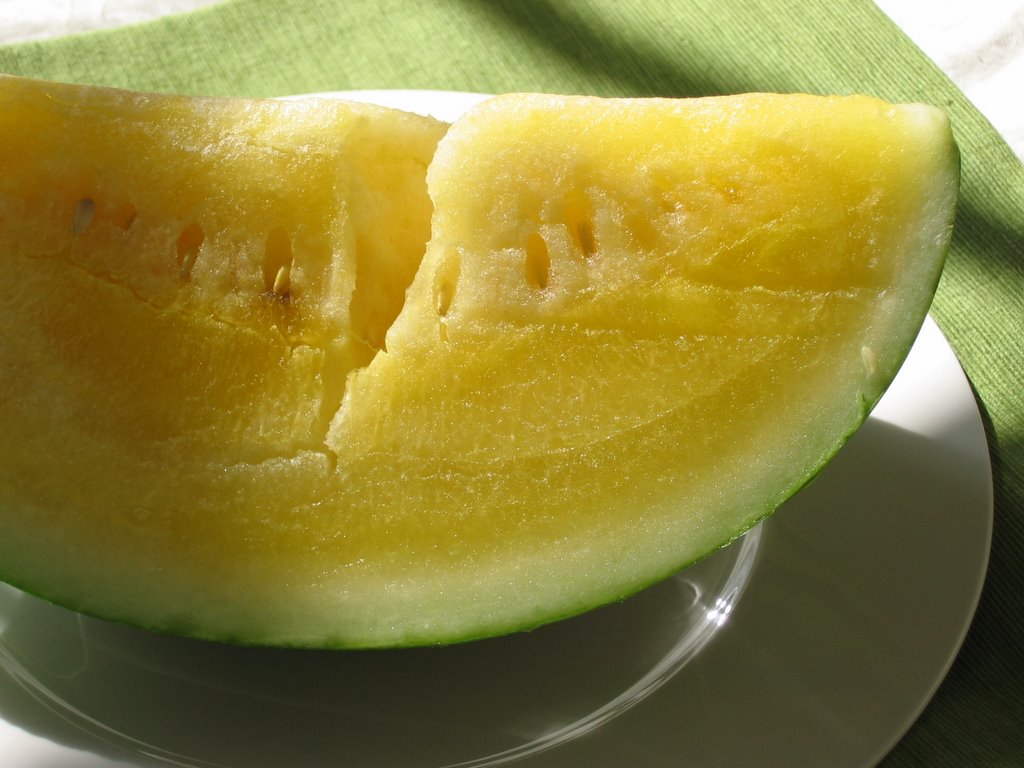
Yellow Watermelon

What? Watermelon comes in yellow? Who knew? I was walking through my market when I came across this beautiful fruit. So of course I had to pick it up and bring it home for a tasting!

Before I tasted it, I wanted to first learn about yellow watermelon. Unfortunately, I could not find very much information on the internet! So I guess in the watermelon world, they do not discriminate between yellow and red watermelons. Such a kind group, they are. Therefore, what I found was just about watermelons in general.

Did you know that there is a watermelon organization called the National Watermelon Promotion Board? I looked at their website and learned how to pick the best watermelon. In summary, you do the following:
  1. Look for a watermelon that is symmetrical and has no bruises, cuts or dents.
  2. The watermelon should be heavy for its size since it is primarily made up of water.
  3. The bottom side of the watermelon should have a creamy yellow spot from where the watermelon sat on the ground growing.
Until you cut open your prized watermelon, you should keep it at room temperature. However, once you have cut into it, you should cover it with plastic wrap and keep the melon refrigerated.
Since the folks at the National Watermelon Promotion Board, well, want to promote watermelons, they also suggested some creative ways to use this summer fruit. One suggestion was to freeze watermelon juice into ice cubes and use them in lemonade. As they note, you will want to strain the watermelon juice to get rid of the seeds and excess pulp.

Okay, let’s get back to my yellow watermelon. After hanging out with the watermelon folks on the internet, I was ready to try it out. As expected, the yellow watermelon tasted much like that of a red one, but I swear it was a bit sweater. The tasted also reminded me a little bit of honeydew mellow. I definitely recommend trying it, if anything, because it is just fun to try out new foods.

The next time I buy a yellow watermelon, I want to use it to make a special cocktail drink. I plan to strain the melon for the juices (de-seeding it if necessary—mine I tried was seedless, putting the fruit into a blender or food processor, and then straining) and then mix the yellow juices with vodka to make Yellow Watermelon Martini’s. Doesn’t that sound good?!

Labels: ,

February 27, 2006

Swiss Chard

So my friend Alison has recently been obsessed with a website that quizzes you on the food you eat and then tells you just how vitamin-deficient you are as a result of your poorly chosen diet. Intrigued, I tried it out myself only to finish the process feeling too malnourished to move from my seat. Okay, so these websites do tend to set the bar pretty high as they are usually created by vegetable-hugging fanatics who think food like cookies are only meant for the devil, but it did make me rush to the produce section my market.

I stood in the produce section looking around for a new vegetable to try. As I was standing here paranoid about my lack of nutrition, the produce guy asked me, “Where are have you been? Hiding? I haven’t seen you here in a while!” Okay, okay, I get the idea. More vegetables, less dinners out. Check.

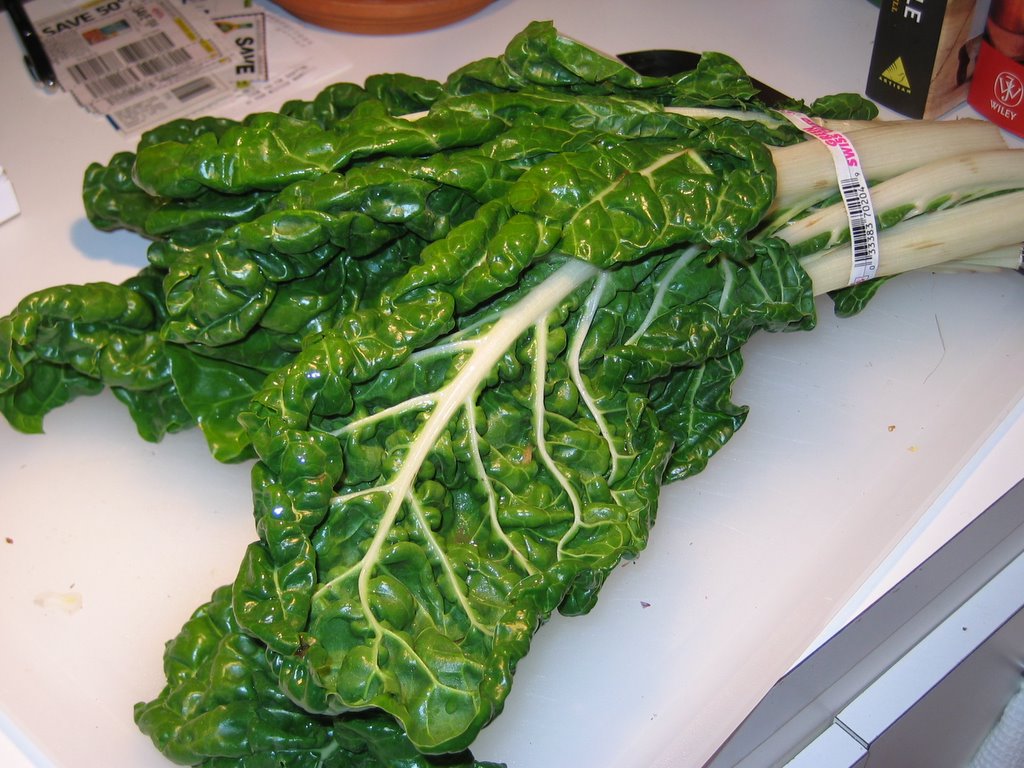
My eyes then settled on the Swiss chard. I have seen cooking shows prepare this leafy green, but I had yet to try it out myself. Knowing that I love spinach, I thought this would be a good variation to try out—and it is a great source of beta-carotene and dietary fiber! So I gathered a bunch of Swiss chard and headed to the checkout counter.

So what is Swiss chard? Well, this large leafy green grows from a special beet (not the kind you are used to eating, but one that is grown for its leaves). If you don’t like beets (for me, this is one of the few foods I dislike), do not let that deter you from eating this green as it has no beet taste! In fact, Swiss chard tastes a lot like spinach (and no bitter taste!).

The Swiss chard I have here has white stalks, but it also comes with red stalks. You may notice from the pictures that the stalks are quite meaty. When you cook the leaves, you need to cut out the stalks but you can save them to cook separately (you can’t cook them all as one since the stalks will take much longer to cook than the leafy part). I did not try the stalks, but I read that they can be prepared just as you would prepare asparagus. I think it would also be nice to add them chopped back to the cooked leaves to allow for a variety of texture to your Swiss chard dish.

As with most leafy greens, Swiss chard must be thoroughly washed. Since it is grown close to the ground, the leaves tend to hold dirt in their crevices. I washed the Swiss chard leaf by leaf under the running faucet, but everything I read suggested taking a big bowl of water and washing the leaves in this , two or three times if needed.

When it comes to preparing Swiss chard, you can pretty much make it just as you would make spinach. Here is how I prepared it (per 2 side servings):
  • 2 cups water
  • ½ bunch of Swiss chard (about 3-4 large leaves), chopped width-wise into 1 inch thick pieces (don’t forget to remove the stems)
  • 2 tbsp butter
  • 1 garlic clove, minced
  • ½ lemon zest
  • Salt and pepper
  1. Boil water in a large sauté pan.
  2. Add Swiss chard and cook until wilted.
  3. Drain water.
  4. In a small, separate pan over medium low heat add butter. Once butter is melted, add garlic and lemon zest. Let cook for a minute (this allows the lemon oils to release themselves from the zest, and for the garlic’s flavor to mellow).
  5. Add butter mixture to Swiss chard and mix.
  6. Add salt and pepper to taste.
Since I had some Swiss chard leftover, I made it again a couple days later (don’t let your Swiss chard sit in your refrigerator for more than two days). Since boiling Swiss chard causes much of the vitamins to transfer to the water, which only is later thrown out, I decided this time to sauté it.

Here is how I sautéed the Swiss chard (per 2 side servings):
  • 1 tbsp butter
  • 1 tbsp olive oil
  • 1 garlic clove, minced
  • ½ lemon zest
  • ½ bunch of Swiss chard (about 3-4 large leaves), chopped width-wise into 1 inch thick pieces (don’t forget to remove the stems)
  • Salt and pepper
  1. In a sauté pan over medium heat add butter and olive oil.
  2. Once butter has melted, add garlic and lemon zest and let cook for a minute.
  3. Add Swiss chard and cook until wilted.
  4. Add salt and pepper to taste.
Overall, I have to admit that I liked the boiled version better—it was smoother tasting. Also the sautéed version left a little film in my mouth, similar to what spinach leaves behind. However, in my quest for earn a higher score on that darn nutrition website I will probably keep to the sautéed version to guarantee my intake of vitamins!

Labels: , ,

February 23, 2006

The Salt of the Earth

Okay, so you think you know everything about salt? This most basic of seasonings actually has a lot more to it than meets the eye so don’t be so cocky...

For starters, aside from being a seasoning, salt is essential to our bodies and is one of the most basic components to the earth (remember—the world is 2/3 covered by ocean salt water, after all). When added to food, it not only helps bring out the flavor, but it also draws out the moisture. Furthermore, salt is a natural preservative for foods. And did you know that at one point in time salt was considered so valuable that it was used as currency? So salt is actually quite a versatile and interesting seasoning. Who knew?

So what are the various types of salt, you ask? Well, here is a summary:

Table Salt
This is your most commonly found salt—think salt shakers at the diner, if you will. Table salt is pulled from dried up underground salt deposits left by salt lakes. It does not dissolve as easily as other salts, which makes it taste stronger since it sits on your tongue longer. It also includes additives to help prevent caking in damp weather. These additives cause a harsher taste than that of other salts. Therefore, table salt is best used in cooking and baking where the taste blends in and not as a finishing salt.

Kosher Salt
Kosher salt is basically table salt that has been rolled into “salt flakes.” The shape of the flakes allows for it to better pull moisture out of food such as meats. Furthermore, the greater surface area allows for it to provide a good strong salt flavor without over salting. Kosher salt does not contain additives so the taste is more pure than that of table salt. As a result, this inexpensive salt is best used for both cooking and as a finishing salt. It also tends to be the most widely used salt by chefs.

Sea Salt
A bit chunkier of a salt is sea salt. As you might guess, it is obtained from ocean water deposits that have dried up leaving behind salt crystals. Sea salt tends to be the priciest of the various salts since it is more difficult to obtain. I primarily cook with a cheaper sea salt that is commonly found in the grocery store. However, more expensive gourmet sea salt should only be used sparingly as a finishing salt because its unique taste is lost when used in cooking (there is no need to waste this precious salt if you can’t taste it!).

The following are some various types of sea salts:

Gray Salt (Sel Gris)
If you watch Easy Entertaining with Michael Chiarello, you most likely have noticed that he is always using gray salt. What is it? Gray salt is found on the Atlantic coast of France. This slightly moist salt gets its light grey color from the clay in the salt flats. Its taste is bold and pure.

Fleur de Sel
This sea salt actually is created from gray salt only when the weather conditions are just right (hence the higher price tag since the supply is not as great). Under these specific conditions the fleur de sel (“flower of salt”) crystals grow from the grey salt. For every 80 pounds of grey salt created, only one pound of fleur de sel is found. For Christmas my mother gave me a bottle of this salt (some people get iPods, I get salt!), and I LOVE it. There is truly a better taste to this salt than that of your normal, everyday salt so I save it for special meals as a finishing salt. Sometimes I dip my finger in it and just have a little taste of the salt on its own (I have also been known to lick the inside of microwave popcorn bags, but whatever). Fleur de sel’s crystals are very delicate, which makes it a delight to taste not only for its flavor but also its texture.

Maldon Sea Salt
This English salt is created by boiling ocean water, which causes pyramid-shaped hollowed crystals that crumble easily between your fingers. This unique shape allows for a delicate, light salt flavor.

So there you go! There is more to salt than you thought, huh?

Labels:

January 29, 2006

Food Focus: Cranberry Beans

Are these not the most beautiful beans you have ever seen? I was walking around the Manhattan Fruit Exchange at the Chelsea Markets when I came across these gorgeous beans. I was instantly intrigued and eager to learn more about them; so I gathered some in a bag, brought them home, and began my research.

I learned that these beautiful legumes, also known as Borlotti, were first cultivated in Mexico and Peru about 7,000 years ago. Then in the 16th century Spanish explorers brought the beans to Europe, and as a result, Cranberry Beans are now a common staple in Spanish, Portuguese, and Italian cuisine.


Despite the fact that this bean is more common in southern European dishes, a large percentage of the beans are actually farmed in the US. Who knew? They are related to the Kidney Bean and in looks are similar to the Pinto Bean but reversed in color with pink skin and red specks. When cooked, magically the red specks disappear—how cool, but where do they go??? Their taste is described as having a creamy texture with a chestnut-like flavor and earthy tone.

Fresh Cranberry Beans might not be so easy to find, depending on the markets you have access to. They are most commonly found in farmers’ markets and specialty grocery stores. You may have an easier time finding them in the dried legume section of your grocery store.

From what I have read about these beans, they are traditionally served in soups or simply on their own with some olive oil and seasonings. Note that you must shell them—the pods are not edible!

Look out for my next post, which will be preparing the beans in the traditional Italian way...

Labels: